 By
By name: iblai-agent-access description: Add the agent Access tab (role-based access control for editor and chat roles) to your Next.js app globs: alwaysApply: false
/iblai-agent-access
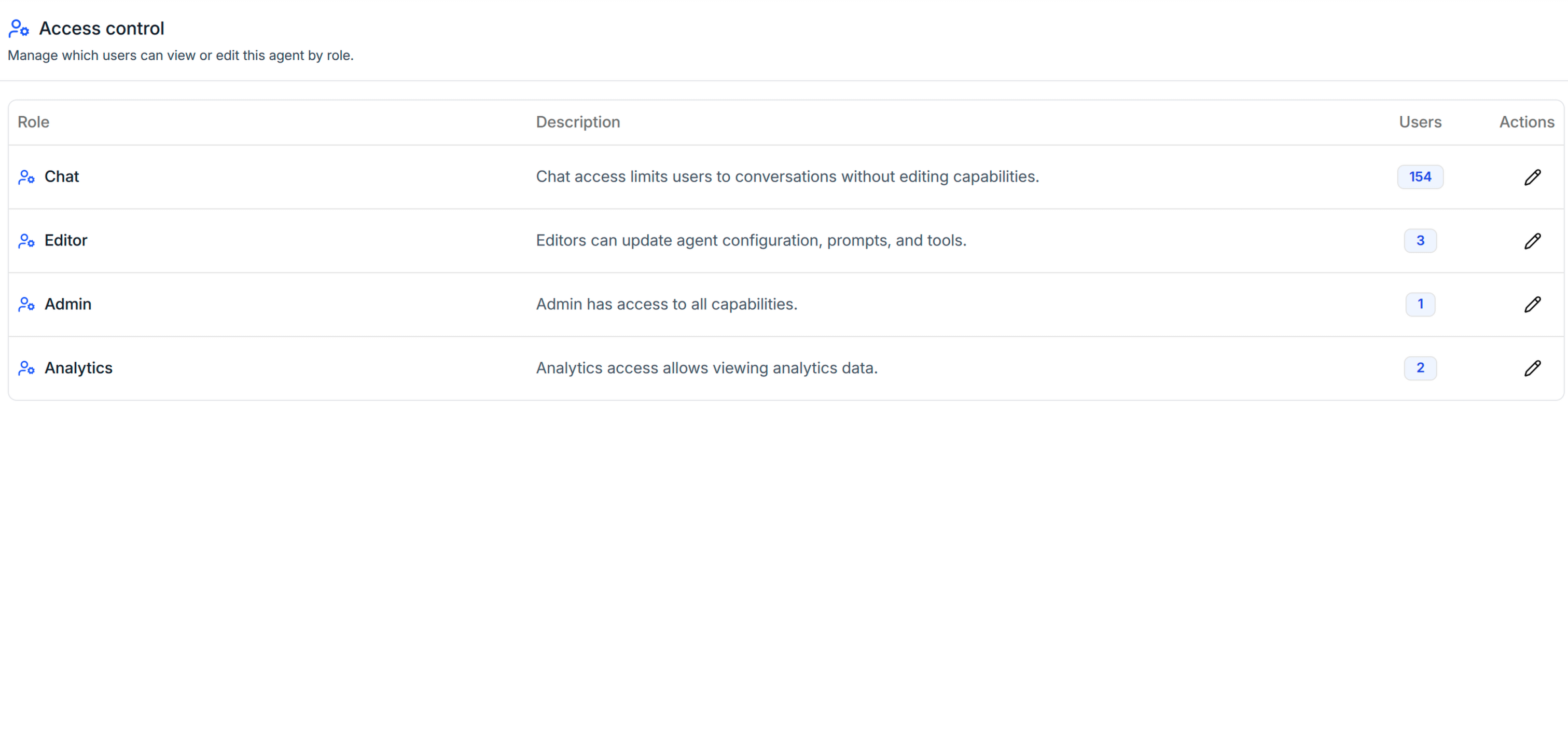
Add the agent Access tab -- role-based access management for agents.
Lets admins assign editor and chat roles, add/remove users and
groups per role, and view existing access policies in a table. This is one
tab in the wider agent-settings family (access, api, datasets,
disclaimers, embed, history, llm, memory, prompts, safety,
settings, tools). All tabs share the same AgentSettingsProvider
wrapper.
Do NOT add custom styles, colors, or CSS overrides to ibl.ai SDK components. They ship with their own styling. Keep the components as-is. Do NOT implement dark mode unless the user explicitly asks for it.
When building custom UI around SDK components, use the ibl.ai brand:
- Primary:
#0058cc, Gradient:linear-gradient(135deg, #00b0ef, #0058cc) - Button:
bg-gradient-to-r from-[#2563EB] to-[#93C5FD] text-white - Font: System sans-serif stack, Style: shadcn/ui new-york variant
- Follow the component hierarchy: use ibl.ai SDK components
(
@iblai/iblai-js) first, then shadcn/ui for everything else (npx shadcn@latest add <component>). Do NOT write custom components when an ibl.ai or shadcn equivalent exists. Both share the same Tailwind theme and render in ibl.ai brand colors automatically. - Follow BRAND.md for colors, typography, spacing, and component styles.
You MUST run /iblai-ops-test before telling the user the work is ready.
After all work is complete, start a dev server (pnpm dev) so the user
can see the result at http://localhost:3000.
iblai.env is NOT a .env.local replacement — it only holds the 3
shorthand variables (DOMAIN, PLATFORM, TOKEN). Next.js still reads
its runtime env vars from .env.local.
Use pnpm as the default package manager. Fall back to npm if pnpm
is not installed.
Common setup (brand, conventions, env files, verification): see docs/skill-setup.md.
Prerequisites
- Auth must be set up first (
/iblai-auth) - MCP server + skills configured (
@iblai/mcpin.mcp.json) AgentSettingsProvidermust wrap the route (see/iblai-agent-settingStep 2 if not already set up)- Ask the user for a real
mentorId(agent UUID). Do NOT invent one.
Step 1: Check Environment
Before proceeding, check for an iblai.env in the project root. Look for
PLATFORM, DOMAIN, and TOKEN variables. If the file does not exist or
is missing these variables, tell the user:
"You need an iblai.env with your platform configuration. Download the
template and fill in your values:
curl -o iblai.env https://raw.githubusercontent.com/iblai/vibe/refs/heads/main/iblai.env"
Step 2: Mount AgentAccessTab
The AgentSettingsProvider layout from /iblai-agent-setting Step 2 must
already wrap this route. The provider supplies tenantKey, mentorId,
username, and enableRBAC via context.
// app/(app)/agents/[mentorId]/access/page.tsx
"use client";

import { AgentAccessTab } from "@iblai/iblai-js/web-containers/next";

export default function AgentAccessPage() {
  return (
    <div className="flex h-full flex-col bg-white">
      <AgentAccessTab />
    </div>
  );
}
Step 3: Customize Labels (Optional)
AgentAccessTab renders with the default agent-facing copy
(AGENT_ACCESS_TAB_LABELS). Override any string via the labels prop:
import {
  AgentAccessTab,
  AGENT_ACCESS_TAB_LABELS,
} from "@iblai/iblai-js/web-containers/next";

<AgentAccessTab
  labels={{
    header: { title: "Mentor access", description: "Manage who can edit or chat with this mentor." },
    table: { columns: { role: "Permission level" } },
  }}
/>;
Step 4: Use MCP Tools for Customization
get_component_info("AgentAccessTab")
get_component_info("AgentSettingsProvider")
<AgentAccessTab> Props
Import from @iblai/iblai-js/web-containers/next.
| Prop | Type | Required | Description |
|---|---|---|---|
labels |
DeepPartial<AccessTabLabels> |
No | Override user-visible strings (header, table columns, empty states, dialogs) |
onPermissionsLoaded |
(permissions: object) => void |
No | Fired when RBAC permissions for /users/ and /groups/ are fetched on mount |
Related Exports
From @iblai/iblai-js/web-containers/next:
AGENT_ACCESS_TAB_LABELS-- the default agent-facing label bundle.AccessTabLabels-- type for the full label bundle (header, table, empty states, edit dialog, create dialog, role descriptions).
Step 5: Verify
Run /iblai-ops-test before telling the user the work is ready:
pnpm build-- must pass with zero errorspnpm test-- vitest must pass- Start dev server and touch test:
pnpm dev &
npx playwright screenshot http://localhost:3000/agents/<id>/access /tmp/agent-access.png
Important Notes
- Redux store: Must include
mentorReducerandmentorMiddleware initializeDataLayer(): 5 args (v1.2+)@reduxjs/toolkit: Deduplicated via webpack aliases innext.config.ts- Peer deps:
sonnerand@iblai/iblai-web-mentormust be installed (pnpm add sonner @iblai/iblai-web-mentor) - Shared provider:
AgentSettingsProvidermust wrap the route at a layout level. See/iblai-agent-settingStep 2 for the full snippet. - RBAC: The tab checks
enableRBACfrom the provider andrbacPermissionsto gate add/edit actions. IfenableRBACisfalse(the default), all actions are permitted. - Default roles:
editorandchat. These come fromDEFAULT_MENTOR_ROLESin the package and are not configurable via props. - Brand guidelines: BRAND.md
RBAC REST API
For custom UI beyond <AgentAccessTab>. All endpoints are prefixed with
${dmUrl}/api/core/ where dmUrl is NEXT_PUBLIC_API_BASE_URL. RBAC state
is scoped per platform — pass platform_key={key} on every request.
Concepts
- Resource paths are hierarchical, rooted at a platform: a policy on
/platforms/1/mentors/5/also applies to/platforms/1/mentors/5/documents/. - Actions look like
Ibl.Mentor/Mentors/read,Ibl.Mentor/Chat/action,Ibl.*(wildcard). - Data actions gate field-level access:
Ibl.Mentor/Settings/display_name/read. Unreadable fields return empty values; unwritable fields return 403. - Policies bind a Role to Resources for Users and/or Groups. Permissions
are additive across all matching policies. Owner well-known roles
(
mentor-owner,document-owner, etc.) are applied automatically when the requesting user owns the resource.
Roles CRUD — Ibl.Core/Roles/...
| Method | Path | Action |
|---|---|---|
| GET | rbac/roles/?platform_key={key} |
list |
| POST | rbac/roles/ |
action |
| GET | rbac/roles/{id}/?platform_key={key} |
read |
| PUT/PATCH | rbac/roles/{id}/ |
write |
| DELETE | rbac/roles/{id}/?platform_key={key} |
delete |
List params: platform_key (required), include_global_roles (default true),
name. Body: { name, platform_key, actions[], data_actions[] }.
Policies CRUD — Ibl.Core/Policies/...
| Method | Path | Action |
|---|---|---|
| GET | rbac/policies/?platform_key={key} |
list |
| POST | rbac/policies/ |
action |
| GET | rbac/policies/{id}/?platform_key={key} |
read |
| PUT/PATCH | rbac/policies/{id}/ |
write |
| DELETE | rbac/policies/{id}/?platform_key={key} |
delete |
List params: platform_key, role_id, name, username, email, group,
include_users, include_groups. Body: { platform_key, name, role_id, resources[], user_ids[], group_ids[] }. Resources must start with
/platforms/ and end with /.
Groups CRUD — Ibl.Core/Groups/...
| Method | Path | Action |
|---|---|---|
| GET | rbac/groups/?platform_key={key} |
list |
| POST | rbac/groups/ |
action |
| GET | rbac/groups/{id}/?platform_key={key} |
read |
| PUT/PATCH | rbac/groups/{id}/ |
write |
| DELETE | rbac/groups/{id}/?platform_key={key} |
delete |
List params: platform_key, owner, name, username, email,
include_users. Body: { platform_key, name, unique_id, description, user_ids[] }.
Permission check (any authenticated user)
POST rbac/permissions/check/
{ "platform_key": "...", "resources": ["/mentors/", "/mentors/42/", "/usergroups/"] }
Returns a map of resource → { list/create/read/write/delete/chat/... }.
Accounts for owner roles automatically. Use this to gate UI actions.
Mentor access — Ibl.Mentor/ShareMentor/...
| Method | Path | Action |
|---|---|---|
| POST | rbac/mentor-access/ |
action |
| GET | rbac/mentor-access/?platform_key={key}&mentor_id={id} |
read |
Body: { platform_key, mentor_id, role, users_to_add[], users_to_remove[], groups_to_add[], groups_to_remove[] }. Roles: chat | viewer | editor.
Substitute usernames_to_add / emails_to_add if you don't have user IDs.
Team (UserGroup) sharing — Ibl.Core/ShareUserGroups/...
| Method | Path | Action |
|---|---|---|
| POST | rbac/teams/access/ |
action |
| GET | rbac/teams/access/?platform_key={key}&usergroup_id={id} |
read |
Body: { platform_key, usergroup_id, role, users_to_add[], ... }. Roles:
read | edit | view analytics | send notifications.
User policy bulk update — Ibl.Core/UserPolicies/write
PUT platform/users/policies/
[{ "user_id": 101, "platform_key": "...",
   "policies_to_add": [...], "policies_to_remove": [...], "policies_to_set": [...] }]
Only platform-assignable policies are allowed. policies_to_set replaces;
removals run before additions.
Platform admin toggles (no extra RBAC action)
| Path | Body |
|---|---|
POST rbac/student-mentor-creation/set/ |
{ platform_key, allow_students_to_create_mentors } |
GET rbac/student-mentor-creation/status/?platform_key={key} |
– |
POST rbac/student-llm-access/set/ |
{ platform_key, llm_resources: ["llms/openai/models/gpt-4o", ...] } |
GET rbac/student-llm-access/status/?platform_key={key} |
– |
Response permission metadata
Resource responses include a permissions object the UI can use to gate
controls:
"permissions": {
  "field": { "display_name": { "read": true, "write": true } },
  "object": { "delete": false, "write": true }
}
Unreadable fields are masked ("", [], or {}) and read: false.
Resource operations
| Resource | Collection ops | Instance ops |
|---|---|---|
mentors |
list, create, chat, web_search, attach_document, voice_record, voice_call, export_chat_history, view_chat_history, view_analytics, view_prompts, share, sell_mentor | read, write, delete + above + show_settings, share_mentor, read_shared_mentor, can_use_embed, view_moderation_logs, view_safety_logs, view_disclaimers |
prompts, documents, tools, settings, llms, mcpservers |
list, create | read, write, delete |
usergroups |
list, create | read, write, delete, share_usergroup, read_shared_usergroup |
users |
list, write | – |
groups, policies, roles |
list, create | read, write, delete |
platforms |
– | can_send_notifications, can_view_analytics, can_manage_users, can_invite |
Built-in roles
Tenant Admin · Students · Mentor Viewer · Mentor Editor · Mentor Chat · Student Mentor Creators · Analytics Viewer · Notification Manager · Enrollment Manager · LLM Users · LLM Model Access · List Users · List Teams · Create Teams · Read Team · Edit Team · Billing Manager.